Real Estate · · 4 min read
From Paper Records to Digital Property Identity: Where Nigerian Real Estate Is Headed

Paper has a problem. It’s slow to search, easy to misfile, expensive to store at scale, and genuinely difficult to update once the information inside it needs to connect to something else.
Moving that information onto a screen solves some of that. It doesn’t solve all of it.
Imagine a land registry has just finished scanning years of old survey files into a searchable digital archive — a real upgrade. But a lawyer running a title search still has to open three separate systems to piece together one property’s full history: the survey in one, the ownership record in another, a transaction from a decade earlier in a third.
Each system works exactly as designed. None of them knows about the other two.
That’s the gap this next stage of digitisation actually needs to close. Not “how do we get more records onto computers,” but “how do we get the computers to agree they’re talking about the same property?”
Getting records out of the filing cabinet is the easy part
Land administration in Nigeria has leaned heavily on physical documents and manual processes for decades, and the limits of that are well known: old records take time to locate, updates are cumbersome, and information rarely moves easily between departments. Spread a property's history across several offices, and reconstructing it becomes a project in itself.
Digitisation changes the mechanics.
A digital record can be indexed, searched, backed up, and pulled up without anyone walking a file from one desk to another.
Nigeria is already moving here. The Federal Ministry of Housing and Urban Development has identified fragmented land records, slow titling, and limited access to land information among the challenges in the country's land administration system, and its Land4Growth programme includes efforts to digitise records and modernise registries.
Oyo State is a working example of what that looks like in practice.
Its Digital Land Survey Plan Registry lets users check whether a survey plan has been captured digitally, while its Property Search service provides information including ownership history, legal status, and encumbrances. Real progress. Also, only the first layer.
A digital record can still be alone in the room
Go back to that lawyer running three separate searches.
All three systems were digital. All three were functioning correctly. The work was still, fundamentally, the old work: find the records, lay them side by side, and manually decide whether they’re describing the same piece of land.
The filing cabinet had disappeared. The fragmentation hadn’t — it had just learned to load faster.
This is why recent federal policy language has started pushing past digitisation on its own, toward the harmonisation of land administration systems and more integrated digital registries. The target has quietly shifted from “get it online” to “get it talking to the other systems.”
What a persistent reference actually changes
Picture a property that changes hands.
A new transaction creates a new record. The previous owner becomes history; the new owner becomes the current record. The property itself doesn't change — it's still the same parcel of land it was before the sale.
If a system treats every transaction as its own isolated record, someone eventually has to reassemble the chain by hand — exactly what that lawyer was doing across three separate logins.
If the system instead holds one persistent reference for the property, every new record can be associated with that same reference. The chain doesn't need reassembling. It was never broken apart in the first place.
A purely digital system answers one question: Can I find this record?
A connected system answers a harder, more useful one: How does this record relate to everything else that's happened to this property?
As more of Nigeria's property information moves online, that second question is the one that determines whether digitisation has actually made the system more useful.
A familiar principle, applied somewhere new
Nigeria’s National Identification Number offers a useful pattern, even though people are a very different kind of thing to identify than land.
NIMC describes the NIN as a unique identifier assigned to an individual and used to establish identity across the national identity system.
Property doesn’t need anything resembling a NIN. But it can benefit from the same underlying principle: a fixed reference that stays constant while everything attached to it — ownership, documentation, use — keeps changing around it.
Oyo State’s OyoGISS platform is already a step in this direction. Its Property Reference System assigns reference codes that anchor a property’s location and support its identification across the state’s geographic and property-information infrastructure.
A reference code on its own isn’t the destination, though.
The real opportunity is for that reference to become the point future records about the property can be associated with — so a property’s file, over time, starts looking less like a folder of unrelated documents and more like one continuously written history.
The progression: Paper → Digital → Connected → Persistent
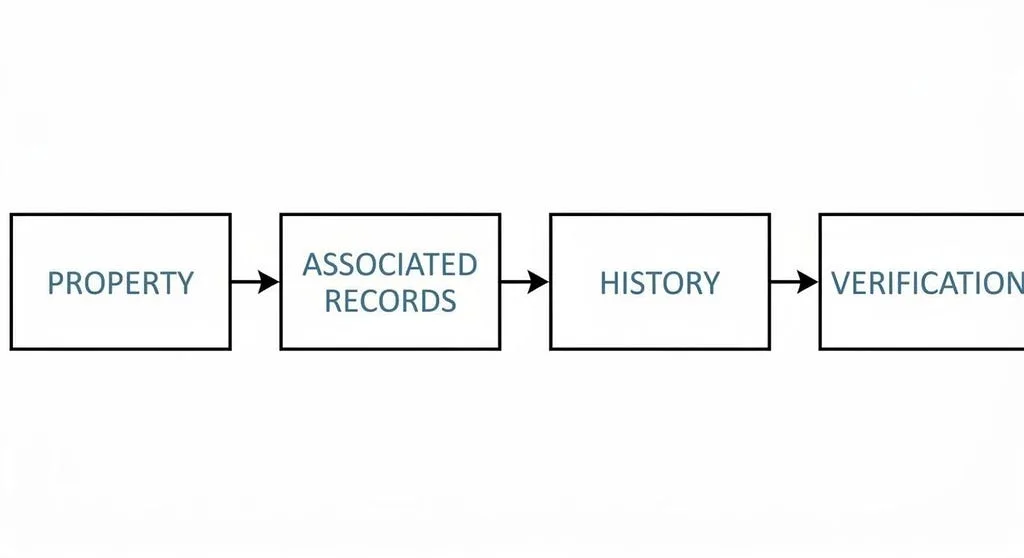
Paper records need to become searchable digital ones.
Digital records need consistent references and the ability to communicate across systems.
Connected records need to stay associated with the property itself as ownership and use shift around it over years and decades.
And underneath all of it, someone still needs to govern who can create, update, verify, and access what.
None of this replaces the lawyer, the surveyor, or the physical inspection.
Digitising a record doesn’t make an inaccurate one accurate. What it can do is make the environment around a property something a professional can actually navigate, instead of something they have to excavate from three different systems that don’t know each other exist.
Originally published on Medium.