Digital Transformation · · 4 min read
Why Real Estate Needs an Identity Layer

A property can have an address, a survey plan, a title document and a transaction history — and still leave you unable to answer one basic question: do all of these actually belong to the same property?
That question sits underneath almost every property dispute, every failed financing application, every transaction that takes longer than it should. The documents exist. What's missing is something that ties them together.
This is where the idea of a property identity becomes useful.
Location tells you where. Identity tells you which one.
An address tells you where a property sits. A survey describes its boundaries. A title establishes an interest. A transaction record shows that something happened.
None of these, on their own, gives a property a persistent identity across its whole history.
Think about a passport.
A person’s address changes. A person’s address, circumstances and other personal information can change over time, but the identifying reference continues to tie different records back to the same individual.
Property needs the same principle of continuity.
A property can change owners, get subdivided, get developed, watch its surroundings transform completely. Through all of it, it should still be recognisable as the same underlying asset — not a new one every time something about it changes.
What would a property identity actually anchor?
A useful property identity would hold together the information that belongs to one specific property: its location, its survey record, its ownership history, its title and related documents, its transaction history, the changes made to it over time, and any interests or restrictions attached to it.
The value isn't in having all of this information somewhere. Nigeria already has plenty of records scattered across plenty of systems. The value is in knowing, reliably, which information belongs to which property — so a new transaction doesn't require reconstructing that property's entire history from separate, disconnected sources every single time.
Identity is about continuity, not ownership
Picture a property that changes owners three times over twenty years.
The ownership record changes each time. The documents change. The people involved change entirely.
The property itself doesn’t become a new property with each transfer. Its identity is the thread running underneath all three transactions — the reason a buyer in year twenty can still trace what happened in year one, instead of starting from nothing.
Most real estate transactions aren’t really about a single moment. A buyer is almost always trying to understand what came before: who held an interest, what was transferred, whether the property was ever divided, what else might still be attached to it.
A persistent identity gives all of that a place to accumulate, instead of scattering with every change of hands.

Identity answers a narrower question than people assume
Giving a property a persistent identity doesn’t make every piece of information attached to it accurate.
A well-identified property can still carry outdated, incomplete, or wrong information — identity and accuracy are solving two different problems.
Identity settles which property a record belongs to. Verification settles whether that record can be trusted. A strong identity system makes verification faster and more structured. It was never meant to replace it.
Nigeria is already building pieces of this
Oyo State’s OyoGISS platform includes a Property Reference System that assigns reference codes to properties, built to support identification and management of property information across the state. Oyo also runs digital property searches and survey-plan searches alongside it.
Each of these tools solves part of the problem. The larger opportunity — the one still largely unbuilt — is making property information persistent and connected across a property’s entire lifecycle, not just searchable in isolated pieces.
What actually changes with an identity layer
Without one, a transaction typically looks like this:
Document → search → another document → another search → reconciliation → professional review
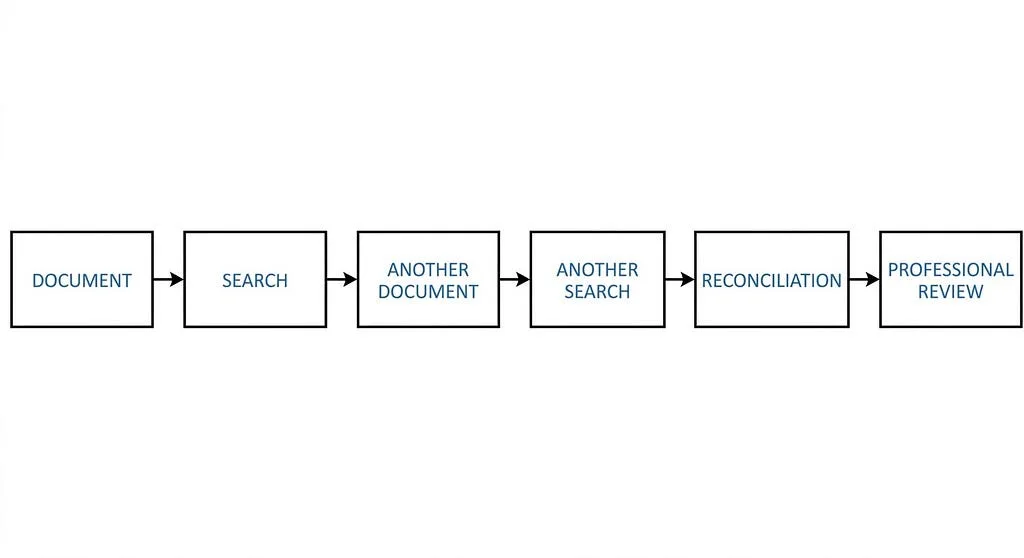
Someone has to manually work out whether everything refers to the same property and how the pieces fit together — every time, for every transaction.
With a persistent property reference, the starting point shifts:
Property → associated records → history → verification
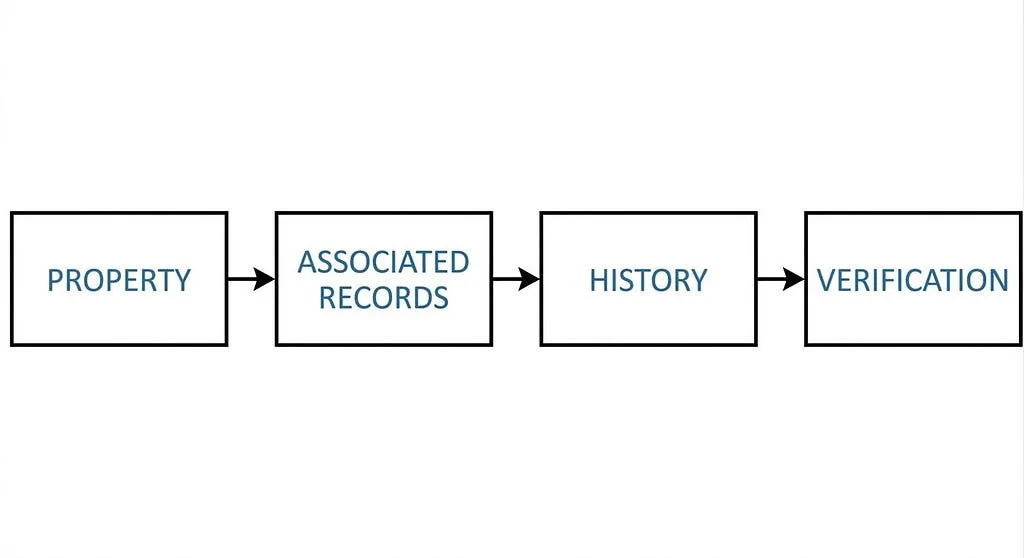
Legal review, surveying, and physical inspection don’t disappear. Professionals still have real work to do. But that work now starts from a clear anchor instead of a pile of documents someone has to first prove belong together.
That shift matters past any single deal. Owners get a property history that’s easier to maintain. Professionals spend less time reconstructing what already happened. Institutions managing planning and land administration get information they can actually rely on. And buyers get a real starting point, instead of a stack of paper they have to piece into a story themselves.
A property should carry its own continuity
Real estate has always generated records. What it’s never reliably had is a way to keep those records tied to the property they actually describe, as that property moves through decades of owners, uses, and changes.
That’s what an identity layer is for — not another document to create, but a fixed point the documents that already exist can finally hold onto.
Originally published on Medium.